



Qingdao Port pushes intelligence deployment









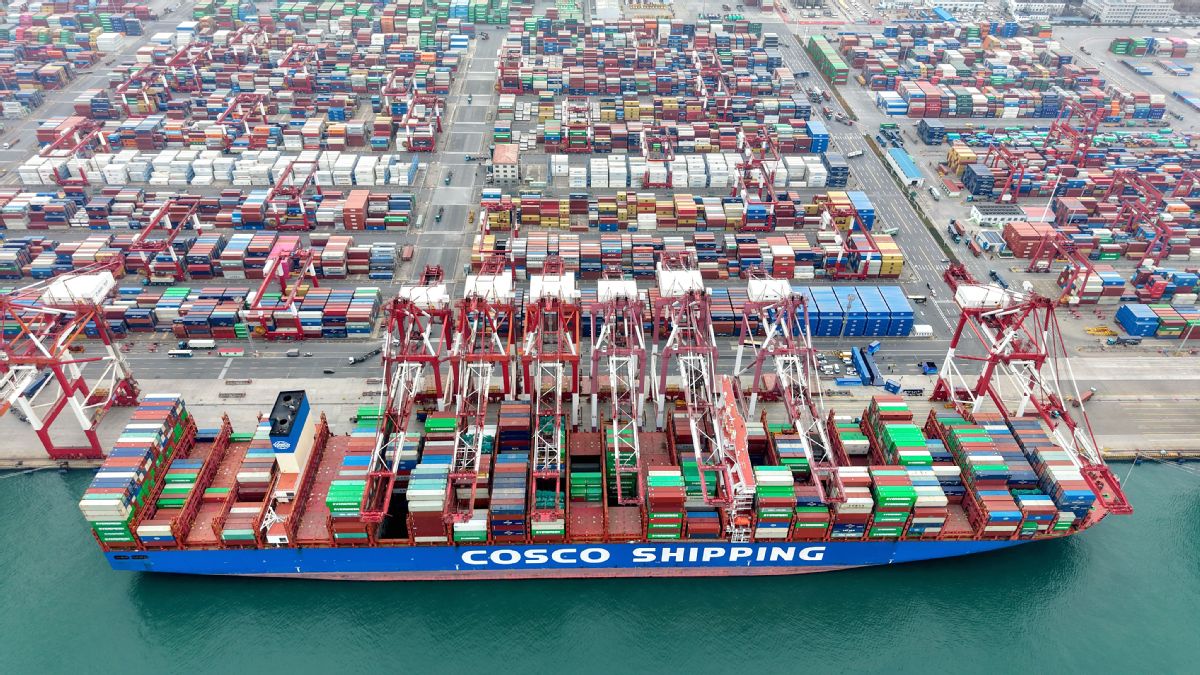
A bulk carrier loaded with iron ore recently docked at Qingdao Port in Shandong province in a routine arrival made remarkable by its technology.
The berthing process was managed not by people, but by an AI system. It finalized the plan in advance, eliminating last-minute recalculations and paper schedules.
Qingdao Port is a subsidiary of Shandong Port Group and one of the world's busiest maritime hubs.
The port's newly developed Berth Planning Agent, an AI-powered system, now analyzes vessel schedules, tidal data and other operational constraints in real time.
Within seconds, it generates the optimal berthing plan and sends synchronized instructions directly to port equipment and terminal systems.
"For years, vessel berthing was one of the most labor-intensive steps in port operations," said Zhao Weili, director of the intelligent automation and control center of Qingdao Port's Qiangang Co.
Under the traditional model, planners had to manually integrate 132 different vessel-related variables and revise plans several times a day.
"If one ship changed, the entire schedule had to be recalculated," she said.
That changed in November, when the AI agent officially went into operation. Since then, the system has continued to evolve from real-world scenarios, refining its decisions with each new vessel.
The AI system's berthing accuracy has reached around 80 percent, significantly reducing the workload for planners and improving overall port efficiency, said Zhao.
As one of China's first batch of national pilot bases for artificial intelligence applications in the transportation sector, the only one in the port industry, the port has used the platform to tackle challenges common across the industry, such as congestion, safety risks and increasingly complex cargo flows.
In Dagang Port Area, where operations involve a mix of general cargo and dry bulk goods, safety is a constant concern. Here, AI has become an extra set of eyes.
Port cameras are now powered by an AI model that detects safety violations. The system is programmed with 208 rules covering major and general port regulations. It monitors 99 critical, high-risk scenarios, capturing images and sending alerts the moment a violation occurs.
"In the past, only few people monitored over 1,500 video feeds at the same time," said Yu Haibo, deputy director of the safety, environmental protection and technology department, Dagang Branch, Qingdao Port International Co Ltd.
Human attention has its limits, but the AI system now covers nearly the entire 9.6 million square meters of the port area, delivering near-total visual coverage, he said.
Automation has also reached the heart of bulk cargo handling. Before conveyor belts start running, AI agents automatically review full-process video feeds to identify foreign objects, achieving a 99.8 percent detection rate with minimal false alarms.
In addition, stacker-reclaimers now use cameras and radar together. They can measure distances precisely, avoid collisions and handle material more intelligently. Automation levels in these operations have climbed to 94 percent.
"Qingdao Port has established 187 data standards and integrated more than 20 data models and applications, offering over 1,000 data services across its operations," said Guo Yiyun, director of the safety, environmental protection and technology department of Qingdao Port.
By turning the AI solutions into standardized and replicable models, Qingdao Port aims to share its experience with the wider industry, helping accelerate artificial intelligence application across China's port sector, he said.



















