


Charm offensive sweeps China









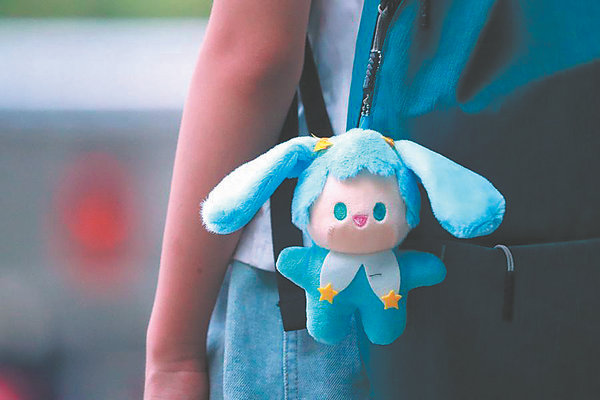
GUANGZHOU — For many young Chinese, the first decision of the day perhaps isn't just what to wear, but which plush companion to clip onto their bags.
"Which doll should I take out today?" This simple question marks a burgeoning trend across China, where bag charms have evolved from simple accessories into a unique language of self-expression and a booming sector of the "emotional economy".
At a Miniso Land store on Beijing Road, a bustling pedestrian street in South China's Guangzhou, Guangdong province, the trend is palpable. An entire wall is dedicated to bag charms, featuring everything from classic IPs like Hello Kitty and Harry Potter to trending favorites like Chiikawa and characters from the recent Zootopia 2.
Shoppers, mostly young people, crowd the aisles, some clutching over a dozen items, waiting for checkout. Prices range from tens to hundreds of yuan (10 yuan equals $1.4), but the enthusiasm is uniform.
"Bag charms are not just decorations; they are mobile 'mood regulators' and visual carriers of young people's identity," says Liu Xiaobin, vice-president and chief marketing officer of Miniso.
Liu notes that charm products now account for over 35 percent of the brand's total plush toy stock. "Since the beginning of this year, our total sales of charm products have exceeded 12 million units," he adds.
The craze is equally visible online. On Red Note, also known as Xiaohongshu, a lifestyle-sharing platform, the hashtag "Everything can be hung on a bag" has garnered over 130 million views. Netizens eagerly share their matching strategies and "socialize" through their shared love for specific characters.
Xu Xinyue, an associate professor at the Institute for Cultural Industries at Shenzhen University, interprets the trend as a shift in consumption psychology.
"Generation Z (born in 1995-2009) pays more attention to self-expression," Xu says. "Bag charms perfectly match their needs for emotional regulation, identity display, and connection with social circles."
Unlike static figurines kept in display cabinets, bag charms possess a "portable" advantage, offering all-day companionship, which has pushed manufacturers to innovate rapidly to keep up with diverse demands.
In Yiwu, the world's hub of small commodities in East China's Zhejiang province, manufacturers are racing against time to satisfy the market's appetite.
"We started receiving frequent inquiries about bag charms from domestic and international clients early this year, so we entered the market quickly," says Lu Yi, general manager of an accessories and decoration company in Yiwu.
To stay trendy, Lu's company develops about 100 new products monthly, averaging three to four new designs daily. "We have also secured IP authorizations for popular characters like B.Duck and Sanrio, which are highly favored by wholesalers," Lu says.
Meanwhile, in the manufacturing hub of Dongguan, Guangdong, companies are adding technological value to small items.
According to Zhang Hua, domestic sales head of an electronic technology company based in Dongguan, the market has expanded from original designs and IP collaborations to include animations, comic and game merchandise and smart companionship products.
Zhang's company recently launched an original brand featuring a smart plush charm equipped with a large AI model. "It sold 20,000 units within just three days of its launch," Zhang says.
The trend is also bolstering other industries. Cultural tourism sites across China are launching distinctive bag charms that serve as "mobile business cards" for regional heritage. Hit films and TV dramas are releasing character charms to extend their popularity beyond the screen.
"With consumption upgrades and the deepening of the 'emotional economy', these small and beautiful items will continue to be an important part of young people's lives," Xu says.