


Experts unite to preserve legacy of ancient buildings









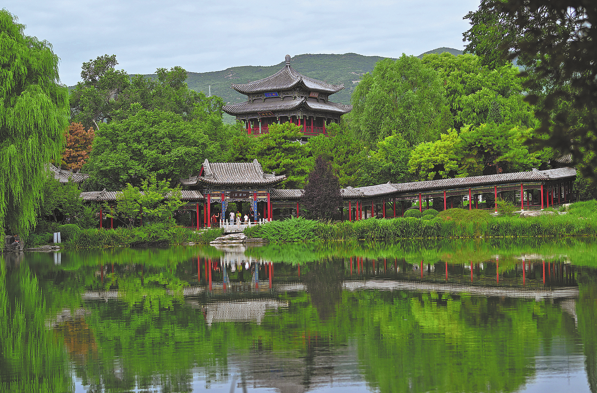
China and France are expanding their cooperation in the preservation of ancient buildings.
For example, a six-day Sino-French academic workshop on the systematic protection of Jinci Temple's heritage architecture and its surroundings was held earlier this year.
The royal ancestral temple complex, 25 kilometers away from downtown Taiyuan, capital of Shanxi province in North China, dates back to the Western Jin Dynasty (265-316). It features a diverse range of ancient architecture, sculptures, murals, steles and trees from multiple dynasties.
The workshop, held in late July, attracted more than 30 experts in cultural heritage conservation from China and France to exchange insights on the preservation and development of the architectural heritage of Jinci Temple.
Topics discussed at the event included the systematic conservation of the temple's cultural landscape from an integrated perspective of cultural and natural heritage, as well as the comprehensive protection, utilization and tourism development of the temple and its surrounding environment.
During the intensive six-day schedule, the Sino-French expert team conducted a comprehensive and multidimensional study of the ancient architecture clusters, stone relics and historical water systems in the core area of Jinci Temple, as well as surrounding sites, such as the Tianlong Mountain Grottoes, Longshan Mountain Grottoes, the ancient villages of Diantou and Chiqiao, and the agricultural heritage of the Qingxu grape-producing region.
Multiple thematic exchanges were held during the academic workshop. Drawing on on-site investigations and extensive discussions with local communities, the experts proposed targeted recommendations for systematic protection. These included water system management, stone relic preservation techniques and the coordinated development of ecological tourism.
Their aim was to explore innovative methods for the integrated and holistic conservation of this precious cultural landscape and its surroundings.
The workshop was wrapped up with a seminar at the Taiyuan Museum on July 28, when the recommendations on Jinci in Shanxi province were announced.
The release of the recommendations not only signifies the workshop's production but heralds a new chapter of deep collaboration between China and France in the field of cultural heritage protection, organizers said.
The workshop has played a key role in deepening the shared understanding of cultural heritage, promoting its adaptive reuse and raising public awareness of heritage preservation, they noted.
Both sides look forward to jointly establishing future directions for cooperation, creating long-term mechanisms, and fostering regular dialogue and experience sharing, they added.
"The Chinese and French experts believe that cultural heritage, as a collective memory of long-term interactions between humans and nature, must be preserved in integrated and systematic approaches," Zhang Chunyan, a professor of architecture from Tianjin University, one of the event's organizers, told China News Service.
"This consensus breaks through the traditional limitations of heritage conservation, which often emphasizes individual structures while neglecting the environment. It expands the scope of protection to include natural landscapes, cultural environments and social spatial structures related to cultural heritage.
"Both sides anticipate that in the future, China and France will place greater emphasis on the protection of large-scale regional heritage, promoting a shift in planning methods toward research-based and collaborative approaches," said Zhang.
Former French prime minister Jean-Pierre Raffarin told China News Service that culture serves as fertile ground nurturing joint projects between China and France, characterized by creativity and inspiration.
Building on the exemplary Sino-French cultural collaboration, the two nations can join hands to advance cooperation in third-party countries, opening a new chapter for their partnership, unlocking new prospects for development, and thus creating more opportunities for cross-cultural exchange through mutually beneficial cooperation, Raffarin said.