



Bookstores enter renaissance period









But financial realities also loom and the industry relies on innovation and government support to keep doors open
Light Space hopes to prove a bright idea to lure readers into bookstores.
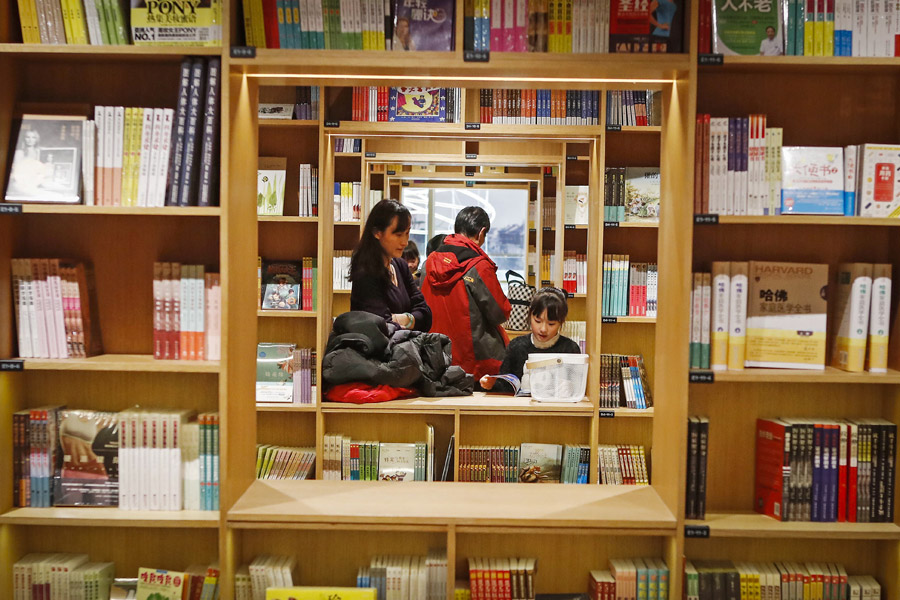
The newly opened Xinhua Bookstore branch in Shanghai was designed by Japanese architect Tadao Ando, who is known for his use of light and shadow.
Indeed, light illuminates structures, and reading brightens people's minds.
Ando, 77, winner of the 1995 Pritzker Prize, often called the "Nobel of architecture", employs his other signature style elements in Light Space, including the use of raw concrete and egg-shaped structures.
Another concept is the theme of "encounter", which is demonstrated by the bookshelves, which are hallowed out in the center so readers see one another through them.
"I hope the space will increase people's encounters with one another and with the books," Ando said in a visit to the construction site in 2016.
Light Space is one of over 20 large bookstores that opened in Shanghai in 2017. Big cities such as Beijing, Nanjing, Shenyang and Hefei also are seeing more bookstores open.
Their recent development is partly thanks to national and local government measures introduced in June 2016, including subsidies, tax breaks and expedited business permits. More than 5 billion yuan ($791 million) of tax money has been exempted annually since 2013, People's Daily reported. And the Ministry of Finance has provided 670 million yuan in bonuses to bookstores during the past five years.


- Search for survivors continues following deadly accident
- Wuxi expands friendship circle through culture, music
- Disabled entrepreneur's inspiring comeback story
- Global voices explore creativity for sustainable cities in Wuxi
- Xi cites philosophy of harmony to promote China-US coexistence
- Qingdao hosts diverse carnival of Chinese cuisine





